Francesco Romero was the grandfather of the celebrated Pedro Romero, who was a prolific matador of his time and was responsible for advancing the blood sport into the “art” form it is today. A namesake of the grandson was glorified in The Sun Also Rises by Ernest Hemingway.
Romero never made any contortions, always it was straight and pure and natural in line. The others twisted themselves like corkscrews, their elbows raised, and leaned against the flanks of the bull after his horns had passed, to give a faked look of danger. Afterward, all that was faked turned bad and gave an unpleasant feeling. Romero’s bull-fighting gave real emotion, because he kept the absolute purity of line in his movements and always quietly and calmly let the horns pass him close each time. He did not have to emphasize their closeness. Brett saw how something that was beautiful done close to the bull was ridiculous if it were done a little way off. I told her how since the death of Joselito all the bull-fighters had been developing a technic that simulated this appearance of danger in order to give a fake emotional feeling, while the bull-fighter was really safe. Romero had the old thing, the holding of his purity of line through the maximum of exposure, while he dominated the bull by making him realize he was unattainable, while he prepared him for the killing.
The Sun Also Rises, Ernest Hemingway
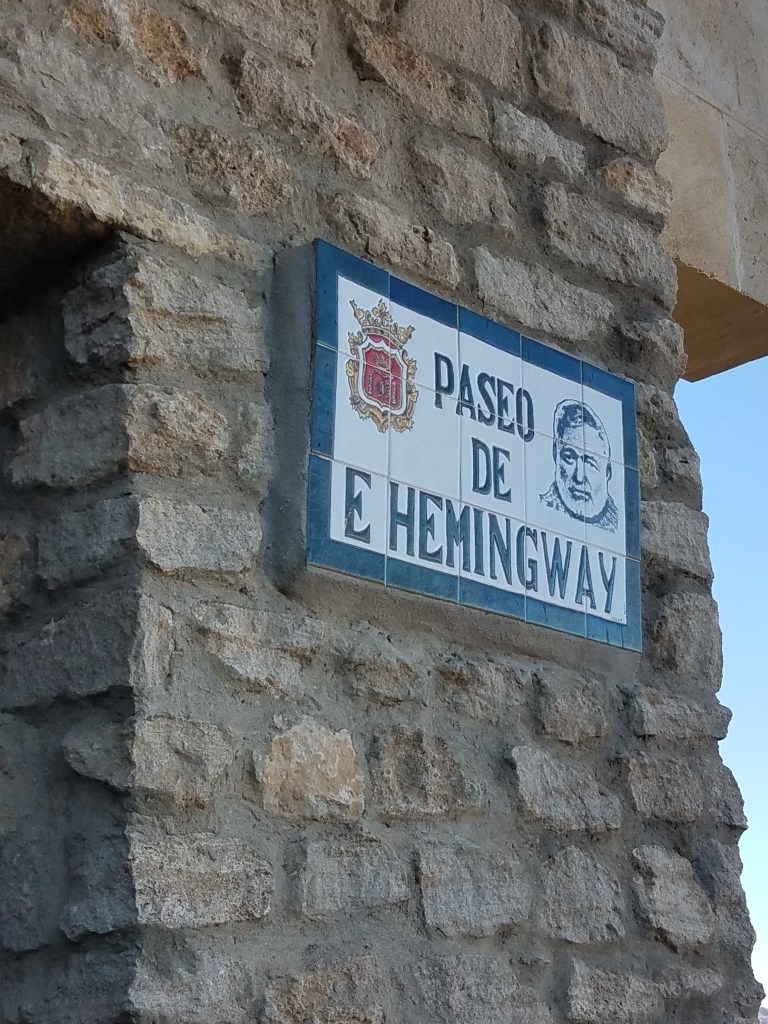
Apart from winning the Nobel Peace Prize in Literature in 1954 and his well-documented brushes with infidelity, what was lesser known about Hemingway was his affection for Spanish bullfighting. His passion for Spanish culture extended beyond just sport however.
In another of his novels set in Spain, For Whom The Bell Tolls, Ernest recounts the atrocities of the Spanish Civil (which he covered as a news correspondent) in the fictionalized killing of fascists in Ronda.
“From a balcony some one cried out, ‘Qué pasa, cobardes? What is the matter, cowards?’ and still Don Benito walked along between the men and nothing happened. Then I saw a man three men down from where I was standing and his face was working and he was biting his lips and his hands were white on his flail. I saw him looking toward Don Benito, watching him come on. And still nothing happened. Then, just before Don Benito came abreast of this man, the man raised his flail high so that it struck the man beside him and smashed a blow at Don Benito that hit him on the side of the head and Don Benito looked at him and the man struck again and shouted, ‘That for you, Cabron,’ and the blow hit Don Benito in the face and he raised his hands to his face and they beat him until he fell and the man who had struck him first called to others to help him and he pulled on the collar of Don Benito’s shirt and others took hold of his arms and with his face in the dust of the plaza, they dragged him over the walk to the edge of the cliff and threw him over and into the river. And the man who hit him first was kneeling by the edge of the cliff looking over after him and saying, ‘The Cabron! The Cabron! Oh, the Cabron!’ He was a tenant of Don Benito and they had never gotten along together. There had been a dispute about a piece of land by the river that Don Benito had taken from this man and let to another and this man had long hated him. This man did not join the line again but sat by the cliff looking down where Don Benito had fallen.
For Whom The Bell Tolls, Ernest Hemingway
This morbid scene can be re-imagined while strolling through the Mirador de Ronda.
FUN FACT: Ernest Hemingway’s writing style is an acquired taste; one that I have never grown accustomed. His choppy prose (though efficient and precise?) lacks the nuance that I look forward to when settling down to enjoy a novel. Maybe it is a foreshadowing of 21st century life where snippets and sound bytes are all that matter or for which audiences have the attention capacity. Imagine a world where shorter and shorter sentences were simply replaced by acronyms. Unimaginable lol!
Nevertheless Ernest Hemingway still holds a special place in the hearts of those around the world.


Leave a comment