
He was no young Salim Kechiouche but shared the same features. A tousle of black curls. Piercing dark brown eyes. A smooth dusky complexion. Thick manicured eyebrows. A delicate tapering chin that lead to a pair of irresistible lips.

He appeared seemingly out of nowhere, like a genie released from a lamp.
For whatever reason, Bob had become obsessed with finding a wooden keepsake box as a souvenir, handmade preferably, and for my part, I was in the market for a new wallet to accommodate the larger-sized European bills. The young stranger claimed he knew exactly where to find “what our hearts desired” as he put it, in the tangle of souks (the iconic open markets of the Arab world) of the medina (the walled city).
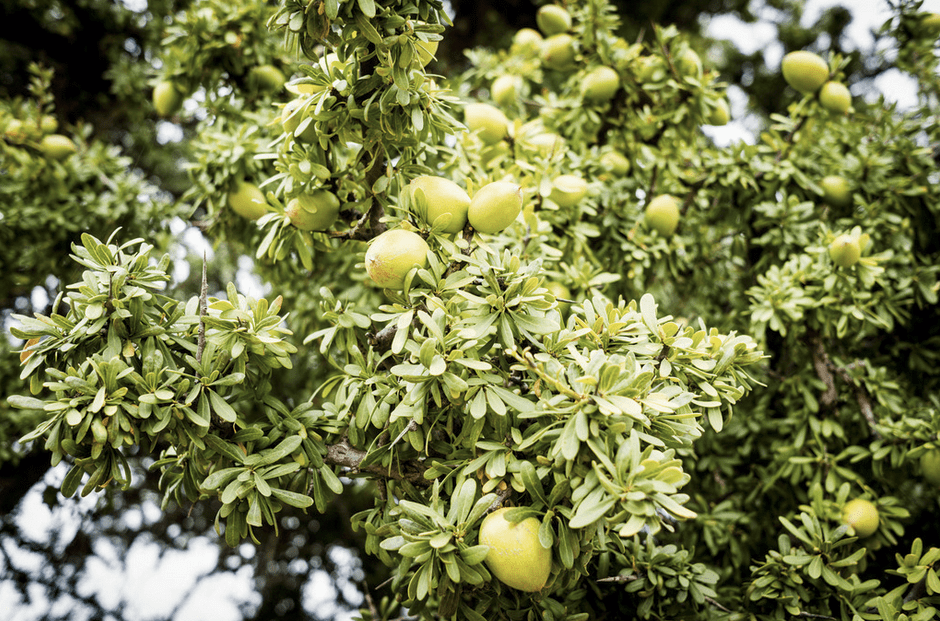
The first stop of our impromptu tour was a women’s consortium where we learned all there was about Argan oil. I was aware of some of the products’ claims (skin moisturizer, hair conditioner, antioxidant) from the beauty commercials back home but that was only part of a fascinating story.
The oil is extracted from the kernels of Argania Spinosa, a flowering tree indigenous to Morocco and neighboring Algeria. Surprisingly, Argan is also utilized for gastronomic purposes. Culinary-grade oil is used as a dressing for salads, as a dip for bread, and as an ingredient in Moroccan classics–couscous and tagine.
We politely declined the offer for complimentary oil massages or to purchase any of their products. Our reasoning being that the women had probably already made a killing off of the dozen or so other spellbound tourists.
SOBERING FACT. The picking, grinding, and pressing of Argan kernels were traditionally the domain of women, who were organized economically into agricultural cooperatives. This beneficial arrangement allowed for income to flow to the most underrepresented members of society. As the merits of the oil spread to the wider world however, these collectives have gradually been usurped by large multinational companies who were able make products more efficiently and at a lower cost. I could only imagine how daunting it must have been trying to sell a local handmade product when competitors, purporting similar benefits, could be purchased at a quarter of the price at a department store.


Leave a comment